![Official Logo of www.vedm.store [Inspired by the Vedas, rooted in Sanatani culture – premium apparel proudly Made in Bharat: T-Shirts, Oversized, T-Shirts, Hoodies, Sweatshirt, Polo T-Shirts, Caps]](https://www.vedm.store/wp-content/uploads/2025/09/www.vedm_.store_.png)

Here’s something strange. We live in an era where a single smartphone holds more information than entire libraries from a generation ago. Students can access MIT lectures while sitting in a small-town café, learn Japanese through apps during their commute, and collaborate on projects with peers across continents. Yet, academic stress has never been higher. Anxiety levels among students have skyrocketed. The average attention span? Shorter than ever.
What’s missing in this equation?
Perhaps it’s the very thing our grandparents understood intuitively—that learning isn’t just about acquiring information. It’s about cultivating wisdom, focus, and inner clarity. This is where Saraswati Puja becomes not just relevant, but essential for today’s students.
The worship of Goddess Saraswati, the deity of knowledge, music, arts, and wisdom, might seem like an ancient tradition in our AI-powered world. But dig deeper, and you’ll find it addresses the core challenges modern learners face: distraction, purposeless consumption of information, and the loss of reverence for knowledge itself.
Let me take you through why this centuries-old practice holds answers to very 21st-century problems.
Saraswati Puja: More Than Just a Ritual
The Goddess of Knowledge in Hindu Tradition
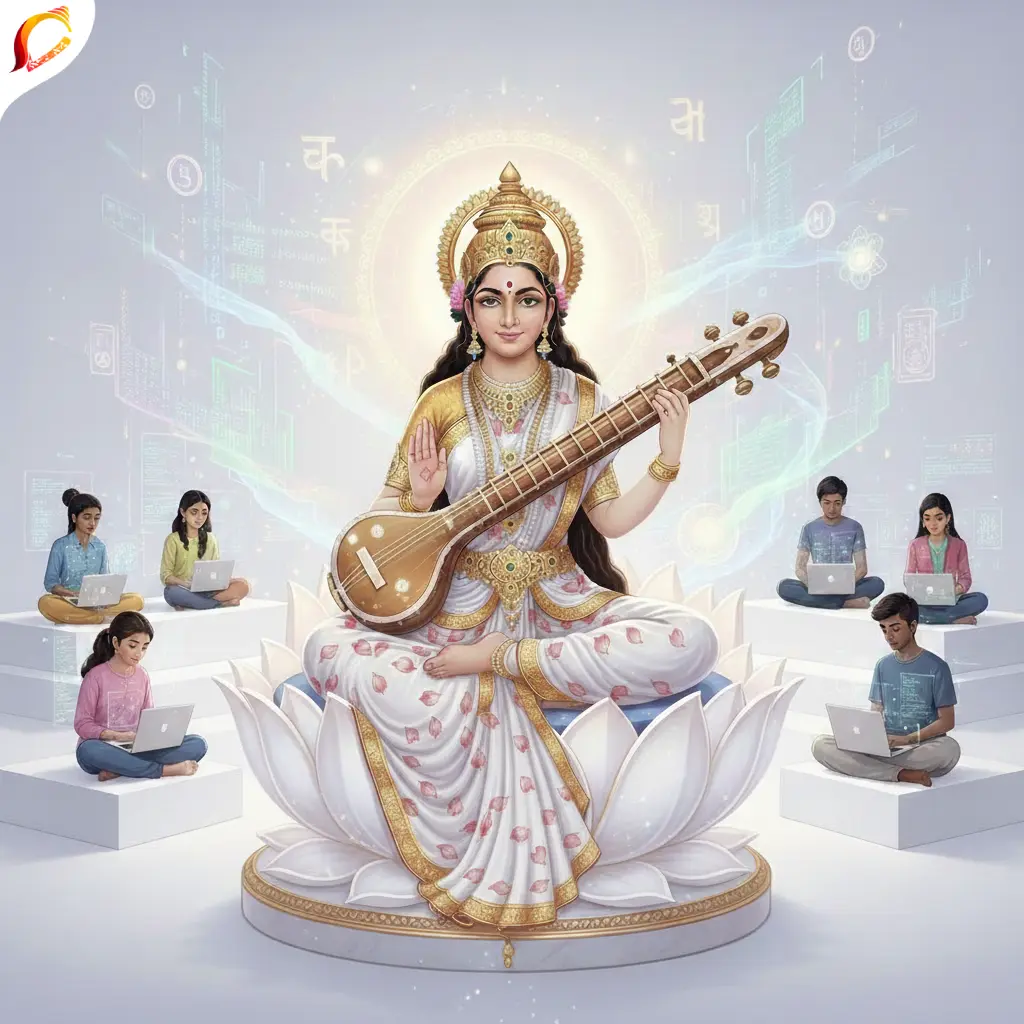
Saraswati represents the flowing river of consciousness and intelligence. Dressed in pure white, seated on a lotus, holding a veena (musical instrument) and sacred texts, she embodies the perfect balance between analytical knowledge and creative expression. Her four hands symbolize mind, intellect, alertness, and ego—the four aspects of human learning.
Traditional celebrations occur during Vasant Panchami, usually in January or February, marking the arrival of spring. Students place their books, musical instruments, and study materials before the goddess, seeking blessings for academic success and creative pursuits.
But here’s what most people miss: the ritual isn’t about magical intervention. It’s about psychological conditioning and creating sacred space for learning.
The Philosophy Behind the Practice
When students participate in Saraswati Puja, they’re engaging in what modern psychology calls “intentional mindfulness.” The act of cleaning study spaces, organizing books, taking a break from devices, and focusing on learning as something sacred creates a mental reset.
Think about it. How often do students today actually pause to honor their education? Most treat learning as transactional—memorize, pass exams, forget, repeat. The puja reintroduces reverence into the equation.
Why Students Need Grounding Now
Information vs. Knowledge: Understanding the Gap
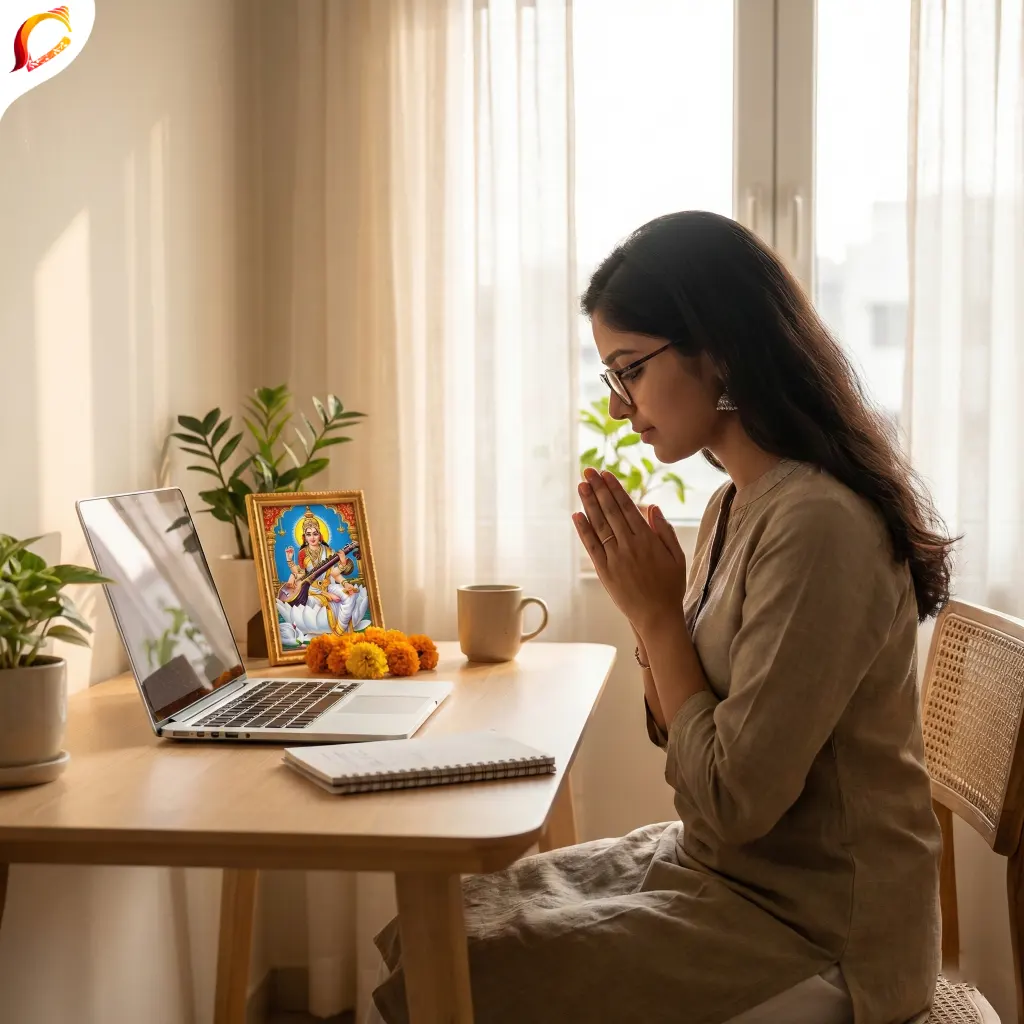
Today’s students face an unprecedented challenge. They’re drowning in information but starving for knowledge. What’s the difference?
- Information: Random facts, disconnected data points, surface-level content
- Knowledge: Contextualized understanding, connected concepts, practical wisdom
- Wisdom: Applied knowledge, discernment, deeper insight
A student might watch a hundred YouTube videos about calculus but still fail to grasp the underlying principles. They might scroll through endless study tips on Instagram but never implement a single one. This is information without transformation.
Saraswati Puja addresses this by encouraging students to step back and ask: “Am I merely consuming content, or am I genuinely learning?”
The Attention Economy and Student Minds
Research from educational psychologists shows that the average student checks their phone 96 times daily. That’s once every ten minutes during waking hours. Each interruption fractures concentration, making deep learning nearly impossible.
Social media platforms are designed to be addictive. EdTech companies compete for screen time. Even educational content gets packaged into bite-sized chunks that rarely allow for sustained thinking.
This is where traditional practices like Saraswati Puja offer something technology cannot: a framework for disconnection and focused intention.
Five Profound Ways Saraswati Puja Benefits Modern Students
1. Creating Sacred Learning Spaces
When students prepare for Saraswati Puja, they clean their study areas, organize materials, and create aesthetically pleasing environments. This isn’t superstition—it’s neuroscience in cultural practice.
Studies on environmental psychology confirm that organized, dedicated learning spaces significantly improve focus and retention. The ritual of preparation itself signals to the brain: “This is important. This deserves attention.”
Compare two scenarios:
Scenario A: Studying while lying in bed, laptop balanced precariously, phone buzzing with notifications, Netflix paused in another tab.
Scenario B: Sitting at a clean desk, materials organized, devices silenced, a small lamp creating focused lighting.
Which environment promotes better learning? The puja ritual naturally cultivates Scenario B.
2. The Power of Intentional Breaks
Digital learning never stops. Online courses run 24/7. Assignment portals don’t close. This creates a toxic culture of perpetual availability and never-ending work.
Saraswati Puja mandates a break. On this day, students traditionally don’t engage in formal studies. Instead, they reflect, celebrate, and reset.
Modern productivity research strongly supports such practices. The concept of “strategic renewal”—taking purposeful breaks to restore mental energy—has been shown to improve long-term academic performance far more than grinding without rest.
Ritvik, a computer engineering student from Bangalore, shared his experience: “I used to feel guilty taking breaks. Like every minute not coding was wasted. After participating in Saraswati Puja with my college group, I realized that stepping back actually made me sharper when I returned to work. That one day of not studying made the next month more productive.”
3. Balancing Analytical and Creative Intelligence
Look at Saraswati’s veena. It represents music, creativity, arts—the right-brain activities often neglected in our STEM-obsessed education system.
The goddess doesn’t just hold books; she holds a musical instrument. The message? True wisdom requires both logical thinking and creative expression.
Today’s students often specialize to the extreme. Engineers who can’t write coherently. Literature majors who panic at basic statistics. The digital age has made this worse with hyper-specialized algorithms feeding us content in narrow silos.
Celebrating Saraswati Puja reminds students to pursue holistic development. Maybe that medical student should also learn guitar. Perhaps the business major would benefit from poetry. This balanced approach creates not just better students, but more complete human beings.
4. Community Learning in an Isolated World
Despite being more “connected” than ever, students report higher levels of loneliness. Online learning platforms, remote education, and digital-first interactions have eroded the communal aspects of education.
Saraswati Puja is inherently communal. Families celebrate together. Schools organize collective prayers. College students gather in hostels for group celebrations.
This creates what educational researchers call “social learning networks”—informal communities where knowledge sharing happens organically. During puja celebrations, seniors share exam strategies with juniors, study groups form naturally, and academic discussions happen outside formal classroom pressure.
Ananya, a medical student, recalls: “During Saraswati Puja in my hostel, I was struggling with anatomy. A final-year student performing the puja noticed and spent an hour explaining concepts using simple examples. That informal teaching moment helped more than weeks of lecture videos.”
5. Mindfulness and Mental Health
Perhaps the most crucial benefit: Saraswati Puja cultivates mindfulness at a time when student mental health is in crisis.
The ritual components—lighting lamps, offering flowers, chanting mantras, sitting in meditation—are all mindfulness practices disguised as religious tradition. These activities:
- Reduce cortisol (stress hormone) levels
- Improve attention span and focus
- Create psychological distance from anxiety triggers
- Provide sense of purpose and meaning
When a student places their books before the goddess and takes a moment of silence, they’re practicing what secular therapy calls “gratitude meditation” and “intentional grounding.”
Saraswati Puja Practices Students Can Adopt Today
Traditional Rituals with Modern Relevance
You don’t need to be deeply religious to benefit from these practices. Here’s how contemporary students can adapt Saraswati Puja traditions:
1. The Annual Learning Audit Use the puja day to review your academic year. What did you learn well? Where did you struggle? What skills do you want to develop? This reflection practice drives intentional growth.
2. The Digital Detox Day Commit to keeping devices away during puja celebrations. Experience what undistracted thinking feels like. Many students discover they’ve forgotten how to be alone with their thoughts.
3. The Knowledge Gratitude Practice List three things you learned recently that genuinely fascinated you. Not for exams—for yourself. This reconnects learning with curiosity rather than obligation.
4. The Study Space Renewal Deep clean your learning environment. Donate books you’ve outgrown. Reorganize digital folders. Create fresh systems. Physical and digital decluttering improves mental clarity.
5. The Creative Cross-Training Choose one creative activity completely unrelated to your field. If you’re a science student, try creative writing. If you’re in arts, experiment with coding. Honor the holistic vision Saraswati represents.
Creating Your Personal Learning Philosophy
Beyond rituals, Saraswati Puja encourages students to develop a personal philosophy about learning. Ask yourself:
- Why am I pursuing education? (Beyond career goals)
- What kind of learner do I want to become?
- How do I want to contribute knowledge to the world?
- What values guide my academic journey?
These aren’t questions with quick answers. They require the kind of deep reflection that the puja tradition naturally facilitates.
Comparing Traditional and Digital Learning Values
| Aspect | Traditional Learning (Saraswati Puja Values) | Digital Age Learning |
|---|---|---|
| Pace | Deep, slow, contemplative | Fast, surface-level, rushed |
| Focus | Single-subject immersion | Multi-tasking, scattered attention |
| Motivation | Intrinsic curiosity and reverence | Extrinsic rewards (grades, jobs) |
| Community | Guru-shishya, peer learning circles | Isolated, competitive, transactional |
| Knowledge Goal | Wisdom and character development | Information accumulation |
| Learning Tools | Books, discussion, reflection | Videos, apps, quick summaries |
| Success Measure | Understanding and application | Metrics, certificates, credentials |
The ideal approach? Blending both columns. Use digital tools for efficiency while maintaining traditional values for depth.
Integrating Ancient Wisdom with Future-Ready Skills
The Timeless Principles Students Need
Certain principles from Saraswati Puja tradition remain relevant regardless of technological advancement:
Discipline (Tapasya): Whether studying from palm-leaf manuscripts or YouTube lectures, consistent effort matters. The goddess represents the discipline required for mastery.
Respect for Teachers (Guru Puja): In the age of free online courses, it’s easy to forget that someone created that content. Maintaining gratitude and respect for educators—whether in-person or digital—improves learning receptivity.
Continuous Learning (Nitya Adhyayana): Saraswati isn’t the goddess of “graduating and stopping.” She represents lifelong learning, perfectly aligned with our rapidly changing world where skills become obsolete quickly.
Purity of Intention (Shuddha Bhava): Are you learning to genuinely grow, or just to appear impressive? The puja tradition emphasizes examining motivations—crucial when social media makes academic performance performative.
Preparing for an AI-Dominated Future
Here’s an irony: As artificial intelligence handles more information processing, the uniquely human aspects of learning become more valuable. Creativity, wisdom, ethical judgment, emotional intelligence—these are Saraswati’s domains.
Students who cultivate these through practices like Saraswati Puja will thrive in AI-augmented careers. While machines process data, humans who can contextualize, create meaning, and apply wisdom ethically will lead.
Frequently Asked Questions About Saraswati Puja
Is Saraswati Puja only for Hindu students?
Not at all. While rooted in Hindu tradition, the core practices—honoring knowledge, creating learning rituals, balancing analytical and creative skills—are universal. Students from any background can adapt these principles. Think of it like practicing yoga; you don’t need to be Hindu to benefit from meditation and mindfulness.
How can busy students with packed schedules participate in Saraswati Puja?
You don’t need elaborate ceremonies. Even 15 minutes of intentional practice works. Clean your desk, organize study materials, sit quietly with your books, reflect on your learning goals. The consciousness you bring matters more than time spent.
Does celebrating Saraswati Puja actually improve grades?
Directly? No magical intervention exists. Indirectly? Absolutely. Students who practice these rituals report better focus, reduced anxiety, clearer goals, and stronger motivation—all factors that improve academic performance according to educational research.
Can Saraswati Puja practices help with exam stress?
Yes. The mindfulness components, the practice of taking intentional breaks, and the perspective shift from “exams are everything” to “learning is sacred” all reduce unhealthy stress. Many students find that the gratitude practice especially helps during high-pressure periods.
How do I explain Saraswati Puja to non-Indian friends or colleagues?
Frame it as a cultural practice that combines mindfulness, learning rituals, and educational philosophy. Compare it to other traditions that honor knowledge—like academic convocations, thesis defenses, or even the practice of keeping special notebooks. Most people appreciate cultural learning traditions when explained thoughtfully.
What if my family doesn’t celebrate Saraswati Puja traditionally?
Create your own version. The beauty of these practices is their adaptability. Design a personal ritual that honors learning in ways meaningful to you. Light a candle before studying, keep a gratitude journal about what you’ve learned, take a day to reorganize your learning materials—make it yours.
Conclusion:
We’ve traveled through why an ancient practice holds profound relevance for modern students. Saraswati Puja isn’t about blind tradition or religious obligation. It’s about reclaiming something the digital age has stolen—the sacredness of learning itself.
When education becomes purely transactional, when students study only for grades and jobs, when knowledge becomes just another commodity to consume and discard, something essential dies. The joy of discovery. The thrill of understanding. The transformation that real learning creates.
Saraswati Puja reminds us that education deserves reverence. Your books, your instruments, your creative tools—they’re not just objects. They’re portals to growth, windows to new worlds, keys to becoming your fullest self.
As you navigate online courses, AI tutors, and endless digital resources, don’t lose sight of why learning matters. It’s not about accumulating credentials. It’s about becoming wise, becoming whole, becoming truly educated in the deepest sense.
This year, whether you participate in formal Saraswati Puja or simply pause to honor your learning journey, ask yourself: How can I approach education with more intention, more creativity, more heart?
Your ancestors knew something important. Knowledge isn’t just power—it’s sacred. In our screen-saturated, attention-fractured world, maybe it’s time to remember that wisdom.
Ready to transform your learning journey? Start by creating one small ritual that honors your education. Share your experience with fellow students. Explore our collection of mindful learning practices and student wellness resources. Because in the digital age, the students who thrive won’t just be the ones with the most information—they’ll be the ones with the deepest wisdom.
May your pursuit of knowledge be blessed with clarity, creativity, and purpose. Jai Maa Saraswati.
Help vedm to improve, don’t forget to share your thoughts in the comments,